


I build decks for a living, and this is one of the foundation decisions that can completely change how a project moves. I use Diamond Pier on most new deck projects because it usually lets us install the foundation with far less excavation and less disruption than a traditional poured concrete footing.
When this article says a product was installed, used on jobs or tested, that statement refers to firsthand experience. If we do not explicitly make one of those claims, the product-specific evaluation is research-based using current manufacturer documentation, installation requirements, warranty terms and contractor context.
What we compare: use-case fit, installation, durability and maintenance, warranty and support, availability and value.
That does not mean concrete is obsolete. There are still sites where conventional concrete or an engineered foundation is the right answer. The better choice depends on the structure, soil, frost requirements, buried obstacles, access and local approval.

Quick answer
For most of my residential deck projects, I prefer Diamond Pier. It is faster to install, produces much less excavated soil and avoids waiting for site-poured concrete to cure. I still use conventional footing methods when rock, unusual loads, engineering requirements or local conditions make them the better solution.
How the two systems carry a deck
A conventional concrete footing spreads the deck load through a large concrete base or cylinder bearing vertically on soil. The footing normally extends below the required frost depth so seasonal freezing does not lift the deck.
Diamond Pier takes a different approach. A precast concrete head connects to four steel bearing pins driven diagonally into the surrounding undisturbed soil. The pins work together as a foundation group rather than depending on one large excavated concrete mass.

Excavation and property damage
This is one of the biggest differences on a real jobsite.
A concrete footing can require a deep hole with enough diameter or base area to carry the required load. If you have multiple support posts, that can mean a surprising amount of dirt. On a finished property, all of that soil has to be moved somewhere without damaging lawns, patios, fences or landscaping.
Diamond Pier requires only a relatively shallow area for the precast head. The pins do the deep foundation work. On a backyard deck, that difference can be enormous.
Installation time
Traditional concrete usually involves more separate operations: excavation, footing inspection, forming if required, concrete placement and cure time before the project can fully load the footing.
A Diamond Pier installation still needs layout, proper preparation, inspection and the correct equipment, but there is no large site-poured concrete footing to schedule and cure. Once the pier is installed correctly and the inspector is satisfied, we can move ahead quickly.
Equipment
Concrete footings may require an auger, excavator, hand digging, concrete mixer, ready-mix delivery or some combination of those.
Diamond Pier requires the precast heads, four pins per pier, the appropriate driving bit and a compatible automatic breaker/demolition hammer. The manufacturer specifically says a regular roto-hammer is not adequate for driving the pins.
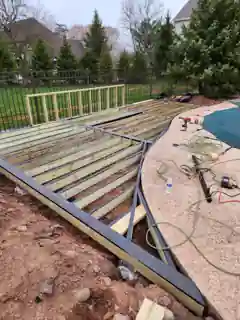
What about frost?
Both systems have to address frost. A traditional footing generally does it by extending the bearing portion below the local frost depth. Diamond Pier uses published pier-and-pin configurations with frost-zone ratings and must be selected and installed according to the manufacturer’s current technical documents and local requirements.
Do not assume that because the concrete head is close to grade, frost no longer matters. The entire system is engineered around the pin geometry, soil interaction and published installation conditions.
Load capacity
Footings are not selected by deck square footage alone. Each support carries a tributary area of the deck. Beam spans, joist spans, snow load, roof load and other factors change how much load lands on each foundation.
Diamond Pier’s current residential data lists DP-50 and DP-75 capacities by soil type and pin length. For example, the DP-50 with 50-inch pins is currently listed at up to 3,300 pounds bearing in qualifying clay/silt soils and 4,400 pounds in qualifying sand/gravel soils. Conventional concrete footings are also sized based on soil bearing and structural load.
Rock and underground obstructions
This is where concrete can sometimes have an advantage. Diamond Pier pins must be driven along their intended path. Large rock or another immovable obstruction can stop a pin. The manufacturer has procedures for dealing with obstructions, including removing and redriving pins or rotating the head, but some sites simply are not good candidates.
With an excavated footing, there may be more flexibility to expose, remove or work around an obstruction. There is no universal winner here; site conditions decide.
Inspection
Both systems still belong in the permit and inspection process. Diamond Pier is not a way to bypass the building department.
One feature I like about the system is that the pins use inspection plugs that allow their installed length to be checked. The exact inspection process depends on the jurisdiction, so the footing plan should be approved before installation.
Diamond Pier vs. concrete: contractor comparison
| Category | Diamond Pier | Concrete footing |
|---|---|---|
| Digging | Minimal excavation | Deep, larger hole |
| Soil removal | Low | Often substantial |
| Cure time | No site-poured footing cure | Concrete cure matters |
| Installation equipment | Breaker hammer + driving bit | Excavation + concrete equipment |
| Finished landscaping | Usually less disruptive | Can create more disturbance |
| Rock/large obstruction | Can stop a bearing pin | Excavation may offer more options |
| Design limits | Published system capacities | Footing designed for load and soil |
| My preference | Usually first choice | Use when conditions call for it |
When I choose Diamond Pier
- New residential decks that fit the published system limits.
- Backyards where I want to minimize excavation and cleanup.
- Properties with finished landscaping or limited access.
- Projects where reducing footing installation time helps the overall schedule.
- Decks where the local permit authority accepts the specified system.
When I would choose another footing
- Major rock or obstructions prevent proper pin installation.
- The structural loads exceed the selected residential pier’s published capacity.
- The project requires a foundation type specified by an engineer.
- Soil conditions fall outside the published assumptions.
- The building department requires another approved design for the specific project.

Bottom line
For me, Diamond Pier is not just a different footing product. It changes the entire footing phase of a deck build. Less digging and less mess are valuable to the crew, but they are also valuable to the homeowner whose backyard we are working in.
If the site and structure are a good fit, Diamond Pier is usually my choice. If they are not, the correct concrete or engineered footing wins. Foundation decisions should be based on what safely supports the deck for the long term—not on forcing one system onto every site.

