


Contractor note: Diamond Pier is one of the products I use more consistently than almost anything else in deck construction. For new deck projects, the DP-50 is usually my first choice for footings whenever the soil, permit, load and site conditions make it appropriate.
When this article says a product was installed, used on jobs or tested, that statement refers to firsthand experience. If we do not explicitly make one of those claims, the product-specific evaluation is research-based using current manufacturer documentation, installation requirements, warranty terms and contractor context.
What we compare: use-case fit, installation, durability and maintenance, warranty and support, availability and value.
I have installed enough traditional concrete footings to know exactly why I prefer a system that lets me avoid digging large holes, mixing or scheduling concrete, waiting for cure time and disturbing half the backyard just to support a deck.

Quick verdict
For the kind of residential deck work I do, Diamond Pier DP-50 is one of my favorite foundation systems. It installs quickly, creates far less excavation than a conventional poured footing, keeps the work area cleaner and can move the project forward without waiting for site-poured concrete to cure.
That does not mean it is automatically right for every structure or every soil condition. Footing loads, soil, frost requirements, buried utilities, obstructions and local approval still matter. But when the project falls within the system’s published limits, this is usually the footing system I want to use.
What is a Diamond Pier DP-50?
The DP-50 is a precast concrete foundation head that uses four galvanized steel bearing pins driven diagonally into undisturbed soil. Instead of relying on one large vertical concrete cylinder, the four pins spread the load into the surrounding soil.
Diamond Pier lists the DP-50 as a residential/light-duty pier intended for applications such as decks, porches, stairs, walkways and similar accessory structures. The current residential system uses four pins per foundation.
Why I use Diamond Pier on deck projects
For me, the biggest advantage is workflow. Traditional concrete footings can turn one part of a deck project into several separate steps: excavate the hole, remove soil, deal with groundwater or collapsed sides, get the hole inspected, place concrete, wait for it to cure and then return to build.
With Diamond Pier, the work is much more contained. The concrete head sits close to grade and the bearing pins are driven into the soil with the proper automatic breaker hammer and Diamond Pier driving bit. Once the pier is installed and approved, the framing process can move ahead quickly.
What I like most
- Less excavation. You are not digging a huge cylinder for every footing.
- Cleaner jobsites. There is much less soil to haul away or spread around the property.
- No site-poured footing cure delay. The concrete head is precast.
- Fast installation. Once the layout and equipment are ready, installation can move quickly.
- Good access on finished properties. This matters on backyards where landscaping, patios and fences make excavation difficult.
- Repeatable system. The same installation sequence can be used from footing to footing.
DP-50 capacity
Always design to the current manufacturer tables and local requirements rather than using one number for every job. Diamond Pier’s current residential information lists a DP-50 with 50-inch pins at up to 3,300 pounds bearing capacity in qualifying clay/silt soils and 4,400 pounds in qualifying sand/gravel soils. Those published capacities come with specific soil, load and use conditions.
The footing layout still has to be based on the actual tributary load carried by each post. A bigger deck, roof load, snow load, longer beam span or unusual structure can change the required pier size or spacing.
How it is installed
A Diamond Pier installation is not simply dropping the head on the ground and hammering pipes into it. The manufacturer has a specific process.
- Confirm the footing locations and locate buried utilities.
- Excavate a shallow tapered area for the precast head.
- Set and level the concrete head.
- Insert the four bearing pins through the head.
- Start the pins and stabilize the head.
- Use an approved automatic breaker/demolition hammer and driving bit to drive the pins incrementally in opposing directions.
- Check level and alignment during installation.
- Finish the pins, install caps and connect the approved post or beam bracket.
Diamond Pier specifically says the pins should be installed with an automatic breaker/demolition hammer using the correct driving bit. A standard rotary hammer is not the same thing.
Where Diamond Pier saves me the most time
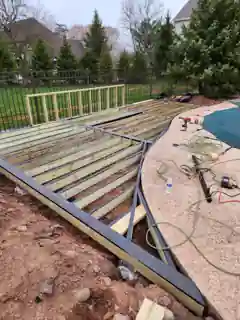
The biggest time savings show up on jobs where access is difficult. If the deck is behind a finished house with landscaping, fences, walkways or a pool, getting excavation equipment and concrete into the yard can become a job by itself.
Diamond Pier lets us keep the footing work concentrated around each support point. That reduces cleanup and makes scheduling easier.
What happens when we hit rock or an obstruction?
This is one of the limitations people should understand. The pins have to reach the required installation depth and trajectory. If a pin encounters an obstruction, the manufacturer’s instructions provide procedures for stopping, checking the obstruction, removing and redriving the pin, rotating the head or relocating the pier when permitted.
If the site conditions simply do not allow the system to be installed correctly, I do not force it. A traditional footing or an engineered solution may make more sense. The footing has to work for the site, not the other way around.

Diamond Pier vs. poured concrete
| Factor | Diamond Pier DP-50 | Traditional poured footing |
|---|---|---|
| Excavation | Small area around precast head | Large deep hole |
| Concrete | Precast head | Concrete placed on site |
| Soil removal | Minimal | Can be substantial |
| Installation speed | Very fast in suitable soil | More steps and cure time |
| Rock/obstructions | Can interfere with pin installation | Excavation can sometimes work around obstacles |
| Design | Must meet published system capacities | Sized by footing area, soil and code |
Who should consider Diamond Pier?
I think it makes the most sense for homeowners and contractors building residential decks, covered decks, porches, stairs and similar structures where the project falls within the published residential system limits and the local building department accepts the design.
Diamond Pier currently states that its retail DP-50 and DP-75 systems are intended for simple residential projects under the conditions in its residential guidance. Larger or more complex projects may require engineered pier systems or another foundation design.

My contractor take
If I am pricing a new deck and Diamond Pier works for the design and site, it is usually what I want underneath the deck. It is cleaner, faster and easier on the property than digging and pouring large concrete footings.
The biggest mistake would be treating it like a shortcut that eliminates structural planning. It does not. You still need the correct number of piers, the correct model and pins, proper installation, load calculations, permits and inspections.
Used correctly, though, Diamond Pier is one of the products that genuinely improves the way a deck gets built.
Frequently asked questions
Is Diamond Pier just for decks?
No. The manufacturer’s residential guidance includes decks, covered decks, walkways, stairs and similar accessory structures within the system’s stated limitations.
Does a Diamond Pier use concrete?
Yes, the head itself is precast concrete. The difference is that you generally are not pouring a large concrete footing on site.
How many pins are in a DP-50?
Four galvanized steel bearing pins are used per pier.
Can you install the pins with a regular rotary hammer?
The manufacturer calls for a compatible automatic breaker/demolition hammer with the proper driving bit; standard roto-hammers are not considered adequate for the installation.
Can Diamond Pier replace every concrete footing?
No. The structure, loads, soil, frost conditions, obstructions and local approval all determine whether it is appropriate.
More Diamond Pier guides
- Diamond Pier vs. Concrete Footings
- How Diamond Pier Footings Are Installed
- Are Diamond Piers Worth It?
- Deck Ledger and Footing Planning Guide

