


When it is time to build a patio, most homeowners land on the same two choices: concrete pavers or stamped concrete. They look similar in photos. They cost roughly the same up front. But they age very differently, they fail very differently, and one of them is far easier to fix.
This guide compares the two on lifespan, cracking, maintenance, looks, drainage, repairs, and DIY feasibility, so you can pick with your eyes open.
Primarily comparing the upfront price? See our focused 2026 paver patio vs. stamped concrete cost guide. This article goes deeper on how the two systems age and what ownership looks like over time.
Quick Comparison
| Factor | Concrete Pavers | Stamped Concrete |
|---|---|---|
| Rough cost per sq ft installed | $15 to $30 | $12 to $20 |
| Typical lifespan | 25 to 50 years | 20 to 30 years with maintenance |
| Cracking | Individual units shift, surface rarely cracks | Will crack eventually, even with control joints |
| Maintenance | Re-sand joints every few years, occasional sealing | Reseal every 2 to 3 years |
| Repairs | Lift and replace single pavers | Patch or replace whole sections |
| DIY feasibility | Very doable with patience | Not recommended |
Costs are rough installed ranges and vary widely by region, patio size, site access, and how much base prep the ground needs.

What Each One Actually Is
Concrete pavers are individual blocks, usually three to four inches thick, set on a compacted gravel base with sand swept into the joints. They interlock with each other. The surface is made of hundreds of separate pieces that can move slightly without breaking.
Stamped concrete is a single poured slab, typically four inches thick, with color added to the mix or the surface. While it is still wet, the crew presses large rubber stamps into it to create patterns that mimic stone, brick, slate, or wood. Control joints are cut into the slab to give cracks a planned place to form.
The key difference is structural. Pavers are a flexible system. Stamped concrete is one rigid piece. That single fact drives almost every tradeoff below.

Cost Per Square Foot Installed
Stamped concrete usually costs less up front. Expect roughly $12 to $20 per square foot installed for a basic stamped pattern with one or two colors. Complex multi-color patterns, borders, and hand-detailed work push it higher.
Concrete pavers typically run $15 to $30 per square foot installed. The spread is wide because paver prices depend on the paver style, the pattern complexity, and the base work. Fancy natural-stone-look pavers and intricate borders cost more.
Base preparation is the hidden cost driver for both. If the soil is soft, the grade needs serious work, or access is tight, excavation and base material can add a lot to either quote. Make sure every bid breaks out the base prep so you can compare honestly.
Over the life of the patio, the cost gap narrows. Stamped concrete needs resealing every couple of years. Pavers need joint sand and occasional sealing. Neither is free to own.
Lifespan
Pavers: 25 to 50 years. The pavers themselves barely wear out. What fails is the base or the edge restraint. A patio with a properly compacted base and solid edge restraint can last decades with minor upkeep. Individual pavers that stain or chip can be swapped out, so the patio never looks its age all at once.
Stamped concrete: 20 to 30 years with good maintenance. The surface color and the sealer are the limiting factors. Sealer wears off, color fades in the sun, and the slab itself has a finite life. A well-built slab on a good base can last longer, but the stamped pattern will look tired without regular resealing.
Durability and Cracking
This is where the two materials split hardest.
Stamped concrete will crack. That is not a flaw in the installer. It is how concrete behaves. Control joints are cut to steer cracks into straight lines where they look intentional, but random cracks still happen. Freeze-thaw cycles, tree roots, and soil movement all work on a rigid slab. Most cracks are hairline and cosmetic. Some are not.
Surface wear is the other issue. The stamped texture and color live in the top fraction of an inch. Years of sun, weather, and foot traffic wear the sealer, then the color. A faded, worn stamped patio is a common sight in older neighborhoods.
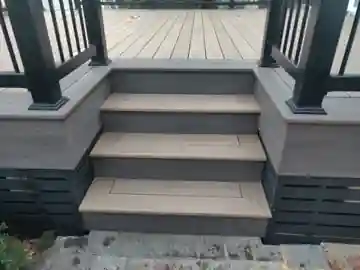
Pavers flex instead of cracking. Because the surface is hundreds of separate units, ground movement shifts individual pavers instead of cracking a slab. You might get some unevenness or settling over the years, but you will not get a crack running across the patio. Pavers also handle freeze-thaw cycles well, which is why they are so popular in cold climates.
Paver surfaces can still wear. The color is through the paver, so it fades much slower than stamped concrete, but cheap pavers can lose their surface texture over decades.
Maintenance
Stamped concrete maintenance centers on the sealer. Plan on cleaning and resealing every two to three years. The sealer is what protects the color and gives the patio that rich, wet look. Skip resealing and the patio fades to a flat gray, the pattern dulls, and water starts working into the surface. Resealing is not hard, but it is a recurring job and a recurring cost if you hire it out.
Paver maintenance centers on the joints. Polymeric sand in the joints hardens to resist weeds and ants, but it breaks down over several years and needs refreshing. Weeds will find any joint that is not well sanded. An occasional pressure wash keeps pavers looking sharp. Sealing pavers is optional. It deepens the color and slows staining, but many homeowners skip it and the patio still looks fine.
Neither option is maintenance-free. Stamped concrete asks for sealer on a schedule. Pavers ask for joint attention on a schedule.
Appearance Options
Stamped concrete wins on pattern variety. It can mimic ashlar slate, flagstone, brick, cobblestone, and even wood planks. Color can be mixed through the concrete and dusted on the surface for depth. Borders, medallions, and custom details are all possible. The catch is that it is still one continuous surface, and up close it reads as concrete no matter how good the stamp work is.
Pavers win on authenticity and texture. Real joints between real units give a patio depth that stamping imitates. The color and texture options are enormous: tumbled, smooth, natural-stone looks, mixed sizes, herringbone patterns, soldier-course borders. A well-designed paver patio looks like it was laid stone by stone, because it was.
Both look good new. Ten years in, the paver patio usually looks better, because its color runs through the material and its surface has not been worn flat.
Drainage
Water has to go somewhere. Both surfaces are essentially waterproof, so the grade of the patio matters more than the material.
Pavers have a small advantage: water can seep through the joints, which slightly reduces runoff. With a permeable paver system (wider joints filled with small stone over an open-graded base), a patio can absorb a real amount of rain. Standard paver patios are not truly permeable, but they shed less water than a solid slab.
Stamped concrete sheds everything. The slab must be pitched correctly, usually about a quarter inch per foot away from the house, or water will pool on it and find its way against the foundation. In freeze climates, pooled water that freezes on the surface accelerates wear.
Either way, make the contractor show you the drainage plan before work starts. Where does the water go in a heavy rain? If the answer is vague, keep asking.
Repair Differences
This is the strongest argument for pavers.
Repairing a paver patio is surgical. A stained, cracked, or settled paver can be lifted out and replaced with a matching unit in under an hour. If a section settles, the crew pulls up the pavers, re-levels the base, and puts them back. The patio looks new again. Repairs are cheap because you reuse almost everything.
Repairing stamped concrete is not. A cracked or spalled section cannot be patched invisibly. Patches never match the color and pattern of the surrounding slab. Real repairs mean cutting out and replacing a whole section, and the new concrete will not match the old. For surface wear, the fix is stripping and resealing, which helps but does not restore the original look.
Think about what sits under the patio too. If you ever need to run a gas line, a drain, or electrical conduit under the patio, pavers lift up and go back down. Stamped concrete gets saw-cut and never looks the same.

DIY Feasibility
Pavers are one of the most DIY-friendly hardscape projects. The work is physical but straightforward: excavate, lay and compact gravel in lifts, screed sand, lay pavers in the pattern, cut edge pieces, compact, and sweep in joint sand. A patient homeowner with a rented plate compactor and a weekend crew can build a genuinely good paver patio. Mistakes are forgiving because you can pull pavers up and redo sections.
Stamped concrete is not a DIY project. You get one shot. The concrete has to be mixed, placed, leveled, colored, and stamped within a short working window before it sets. Stamp timing is a skill learned over years. A bad stamp job is permanent. This is firmly hire-a-pro territory.
If budget is tight and you are handy, a DIY paver patio can save thousands in labor. Just do not skip the base. Almost every failed paver patio failed because of a thin or poorly compacted base.
What to Ask a Patio Contractor
Get at least three quotes with the same scope. Ask each contractor:
- How deep is the base, and how do you compact it? (For pavers, you want several inches of compacted gravel in lifts, not a thin scrape of stone dust. For concrete, ask about base prep and rebar or wire mesh.)
- For stamped concrete: what sealer do you use, and how often will it need resealing?
- For pavers: what edge restraint do you use, and what kind of joint sand?
- How do you handle drainage and slope away from the house?
- What is the timeline, and what happens if it rains mid-pour? (Stamped concrete cannot be stamped in the rain. Ask about the plan.)
- What does the warranty cover? (Workmanship warranties on settling and cracking tell you how confident the contractor is in the base work.)
The Verdict: Pick X If…
Pick pavers if you want the longest-lasting patio, you like the authentic look of individual stones, you want repairs to be cheap and invisible, or you might ever need to get under the patio. They cost more up front and reward you for decades.
Pick stamped concrete if the budget is the deciding factor, you love a specific stone pattern that pavers cannot match at your price point, and you are willing to reseal on schedule to keep it looking good. Hire a genuinely experienced stamp crew, because the installer’s skill is everything.
Pick pavers and do it yourself if you are handy, you have help, and you want to save serious money. The base work is the whole job. Get that right and the rest is laying pieces in a pattern.
If you plan to stay in the house for 20 years, pavers are usually the better value despite the higher up-front cost. If this is a five-year house, stamped concrete gives you the look for less money now. If you’re pairing the patio with a new deck, our composite decking guide can help you weigh a patio against a deck project.
Frequently Asked Questions
Are pavers better than stamped concrete?
For longevity and repairability, yes. Pavers last longer, do not crack across the surface, and can be repaired one piece at a time. Stamped concrete costs less up front and offers more pattern variety. “Better” depends on your budget and how long you plan to stay.
How much does a paver patio cost vs. stamped concrete?
Roughly $15 to $30 per square foot installed for pavers and $12 to $20 for stamped concrete. A 400-square-foot patio lands around $6,000 to $12,000 for pavers and $4,800 to $8,000 for stamped concrete, before any tricky site work.
Does stamped concrete crack?
Eventually, yes. Control joints manage where cracks appear, but concrete moves with temperature and soil, and cracks happen. Most are cosmetic. Good base prep and proper joint placement keep them minimal.
Do weeds grow between pavers?
They can, especially if the joint sand washes out. Polymeric sand hardens in the joints and resists weeds far better than regular sand. Refreshing the joint sand every few years and pulling the occasional weed is the normal routine.
How often do you seal stamped concrete?
Every two to three years. The sealer protects the color and the surface. When water stops beading on the patio, it is time to reseal.
Can you repair stamped concrete to look new?
Not really. Cracks and patches never match the original color and stamp pattern. Resealing refreshes the look, but a damaged slab cannot be made invisible the way a replaced paver can.
Which is better for a pool deck?
Both work, but pavers have the edge. They stay cooler underfoot than sealed stamped concrete, they are less slippery when wet (depending on the finish), and if the pool ever needs plumbing work underneath, pavers lift and reset. Whatever you choose, pick a lighter color and a textured finish for grip.


