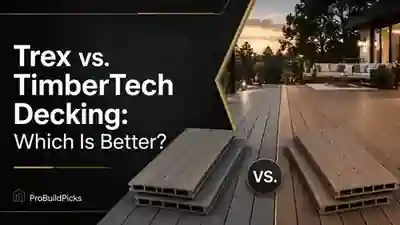
Trex and TimberTech are two of the biggest names in low-maintenance decking, but they are not identical product families. Trex now offers both composite decking and a PVC line, while TimberTech has a broad Advanced PVC lineup plus multiple composite collections.
Affiliate disclosure: ProBuildPicks may earn a commission from qualifying purchases through links in this guide, at no additional cost to you. This article uses current manufacturer product and warranty information plus practical construction considerations.
ProBuildPicks buyer path
Compare first. Buy second.
Use our scoring methodology and related buying guides before choosing a product. We separate homeowner value from contractor-grade priorities so the recommendation fits how the product will actually be used.
Trex vs. TimberTech: The Short Answer
Choose Trex if you want a straightforward tiered product lineup with widely recognized composite options, heat-mitigating choices in select collections and broad retailer availability.

Choose TimberTech if you want a larger selection of Advanced PVC decking, more premium PVC options for moisture-heavy applications or one of its specific wood-look collections and warranty structures.
The most useful comparison is not brand vs. brand. It is collection vs. collection at the same price and performance tier.
Current Trex Product Structure
- Trex Enhance: value-oriented composite decking with 25-year limited residential warranty coverage.
- Trex Select: mid-tier composite with 35-year limited residential coverage.
- Trex Transcend and Transcend Lineage: premium composite options backed by 50-year limited residential warranties. Lineage includes heat-mitigating technology.
- Trex Signature: luxury composite decking with 50-year limited residential coverage.
- Trex Refuge: a newer PVC option designed for ignition resistance and backed by a 50-year limited residential warranty.
Current TimberTech Product Structure
TimberTech separates decking into Advanced PVC and Composite families.
- Advanced PVC: collections such as Vintage, Landmark, Harvest+ and Harvest. TimberTech lists Limited Lifetime product coverage with 50-year fade-and-stain coverage on current Advanced PVC decking.
- Composite: collections including Legacy, Reserve, Terrain+, Terrain, Prime+ and related lines. Current composite warranty periods generally range from 25 to 30 years depending on collection.
Big Difference #1: PVC Selection
TimberTech currently offers a much broader Advanced PVC lineup. That matters for decks around pools, docks, waterfront properties and other places where moisture exposure is one of the top concerns.
Trex now also has a PVC option with Trex Refuge, so the brand is no longer composite-only. Still, TimberTech gives shoppers more PVC collections and aesthetics to compare.
For the material difference itself, see Composite vs. PVC Decking.
Big Difference #2: Warranty Structure
Trex’s current residential decking warranties range from 25 to 50 years depending on collection. TimberTech lists Limited Lifetime product coverage on Advanced PVC with 50-year fade-and-stain coverage, while its composite lines generally carry 25- or 30-year product and fade-and-stain coverage.

Do not compare only the headline number. Review proration, exclusions, transferability, labor coverage, registration requirements and installation conditions for the exact product you are buying.
Big Difference #3: Heat
Trex Transcend Lineage includes heat-mitigating technology and is marketed as cooler than Trex’s original boards. TimberTech markets its Advanced PVC as cooler to the touch than many competitive composite boards. Both manufacturers also warn that decking can still become hot in direct sun and that darker colors generally feel hotter.
If barefoot comfort is important, do not rely on brand marketing alone. Compare the exact colors and product lines in the sun exposure where your deck will be built.
Appearance and Wood-Look Options
Both manufacturers offer realistic wood-grain patterns and multi-tonal colors. TimberTech emphasizes distinct grain styles such as wire-brushed, crosscut, hand-scraped and cathedral-grain looks. Trex’s premium lines also focus heavily on realistic wood appearance and color variation.
- View more than one full board from each color.
- Look for repeating grain patterns.
- Compare boards in direct sun and shade.
- Place railing and fascia samples next to the board.
- Confirm matching accessories before ordering.
Moisture Resistance
For very wet environments, PVC deserves special consideration because it contains no wood fiber. TimberTech’s Advanced PVC is its most moisture-resistant decking family, while Trex Refuge provides a PVC alternative within the Trex lineup.
High-quality capped composite can still perform well in exterior conditions. The correct answer depends on the specific product, installation, drainage and exposure.

Fire-Zone Considerations
TimberTech currently highlights specific Advanced PVC collections for fire-zone applications, including products with ignition-resistant or flame-spread classifications. Trex Refuge is also positioned as ignition-resistant PVC decking. If wildfire or code-related fire performance matters, verify the exact current listing and local requirements before selecting a product.
Joist Spacing and Framing
Both brands require proper framing. For many standard residential composite applications, 16 inches on center is a common maximum, while diagonal installations frequently require 12 inches on center. Some specialty boards can differ. Always use the installation guide for the exact collection.
See our detailed guide: 12 vs. 16-Inch Joist Spacing for Composite Decking.
Which Is Better Around a Pool?
TimberTech Advanced PVC is an especially strong category to compare around pools because of its moisture resistance and the brand’s slip-resistance positioning on certain collections. Trex can also be a good fit, especially when a specific color, texture or PVC option works better for the design.
Which Is Better for a Hot Deck?
Trex Transcend Lineage and TimberTech Advanced PVC both deserve consideration when heat is a priority. Color can matter as much as the product family, so test physical samples in direct sunlight before making the final choice.
Trex vs. TimberTech: How to Choose
- Set the total installed budget.
- Decide whether you want composite, PVC or both.
- Compare collections at similar price tiers.
- Read the exact current warranties.
- Order physical samples.
- Compare heat and color in your actual sun exposure.
- Confirm local availability and lead times.
- Price fasteners, fascia and railings as part of the complete package.
- Confirm joist spacing and framing requirements.
- Choose the product line that fits the project rather than the brand name alone.
ProBuildPicks Takeaway
Trex is strong for a simple, recognizable tiered lineup and broad composite selection. TimberTech stands out for the depth of its Advanced PVC family and broad range of premium wood-look collections. Neither brand is automatically better for every deck. Compare the exact boards, not just the logos.