
Replacing old wood deck boards with composite is one of the most common ways to modernize a deck without automatically rebuilding the entire structure. The big question is whether the existing frame is good enough to justify installing a longer-life surface over it.
Quick answer: current 2026 cost data from Angi places deck resurfacing—replacing the surface while keeping the underlying structure—around $15 to $50 per square foot. Full professional composite-deck installation can run higher because a new-build price includes more of the structure. The real conversion cost depends on demolition, frame repairs, joist spacing, trim, stairs and railing.
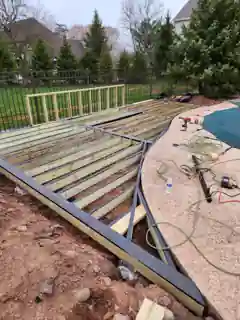
The First Cost Question Is the Frame, Not the Boards
Composite decking can last far longer than neglected wood decking, so it makes little sense to install it over framing that may fail first. Before ordering boards, inspect the ledger, joists, beams, posts, footings, fasteners and flashing.
Read Composite Decking Over an Existing Frame before deciding the frame is reusable.
2026 Planning Range
Using the broad $15–$50-per-square-foot resurfacing benchmark, a wood-to-composite conversion may roughly start in these ranges before major structural repairs or premium add-ons:
| Deck size | Square feet | Broad resurfacing math |
|---|---|---|
| 12 × 16 | 192 | $2,880–$9,600 |
| 12 × 20 | 240 | $3,600–$12,000 |
| 16 × 20 | 320 | $4,800–$16,000 |
| 20 × 20 | 400 | $6,000–$20,000 |
These are planning numbers, not quotes. Replacing railing, rebuilding stairs, adding picture-frame borders or correcting framing can move the final project well above the simple surface-area math.

What the Conversion Usually Includes
- Remove and dispose of the old wood boards.
- Inspect the exposed framing.
- Replace damaged joists or blocking.
- Correct spacing for the new composite product where necessary.
- Address flashing and water-management details.
- Add joist tape if appropriate.
- Install composite decking and approved fasteners.
- Install fascia, borders and breaker boards if included.
- Rebuild or re-skin stairs.
- Reinstall or replace railing.
Joist Spacing Can Turn a Simple Resurface Into a Framing Job
Old wood decks are not always framed the way the new composite product requires. Many boards installed perpendicular to joists commonly allow up to 16 inches on center, while diagonal layouts, stairs or specific product lines may require tighter spacing.
See 12 vs. 16-Inch Joist Spacing for Composite Decking.

Composite Board Price Is Only Part of the Cost
Homeowners often compare only the price of wood and composite boards. A finished conversion also includes labor, hidden fasteners or screws, trim, waste, demolition and the time required to make an older frame flat enough for the new surface.
For a broader new-build reference, Angi’s 2026 composite-decking data places many professionally installed composite decks around $25 to $54 per square foot, with the final project price driven by size, material and prep work. A resurfacing job can be lower because some of the structure remains, but only if that structure needs limited repair.
What About Railings?
If the old railing is still safe, code-compliant for the project and compatible with the new layout, keeping it can reduce cost. But many homeowners use a resurfacing project to switch from wood railing to aluminum, composite or cable.
See Deck Railing Cost in 2026.
What About the Stairs?
Stairs often need more work than the main deck surface because of stringer spacing, tread support, fascia, risers and railing transitions. Reusing the main frame does not guarantee the stair structure can stay untouched.

Should You Add Joist Tape?
With the old boards removed, resurfacing creates a rare opportunity to protect joist tops and other vulnerable areas before they are covered again. Joist tape does not repair damaged framing or replace correct flashing, but it can add another layer of water protection around fastener penetrations.
Read Joist Tape Under Composite Decking.
When Full Replacement Is the Better Buy
- Widespread rot is present.
- Footings are failing or poorly located.
- The ledger connection needs major correction.
- Too much framing must be added or replaced.
- The homeowner wants a substantially different size or shape.
- The repair scope approaches the cost of a properly rebuilt structure.
Use Deck Resurfacing vs. Replacement to make that decision before committing to finish materials.
How to Get a Better Quote
- Ask whether the quote assumes the frame is reusable.
- Ask how hidden framing repairs will be priced.
- Confirm the exact composite collection.
- Confirm the fastening system and border details.
- Separate railing and stair costs from the main surface.
- Confirm demolition and disposal are included.
- Ask whether joist tape and flashing work are included.
- Compare scopes, not just the final number.
Bottom Line
Replacing wood deck boards with composite can be a smart upgrade when the frame is truly sound. The biggest pricing mistake is assuming it is only a board swap. The best resurfacing estimates include demolition, structural inspection, repairs, fastening, trim, stairs and railing so there are fewer surprises after the old surface is removed.
For the broader project budget, see How Much Does a Composite Deck Cost in 2026? and Deck Resurfacing Cost in 2026.